


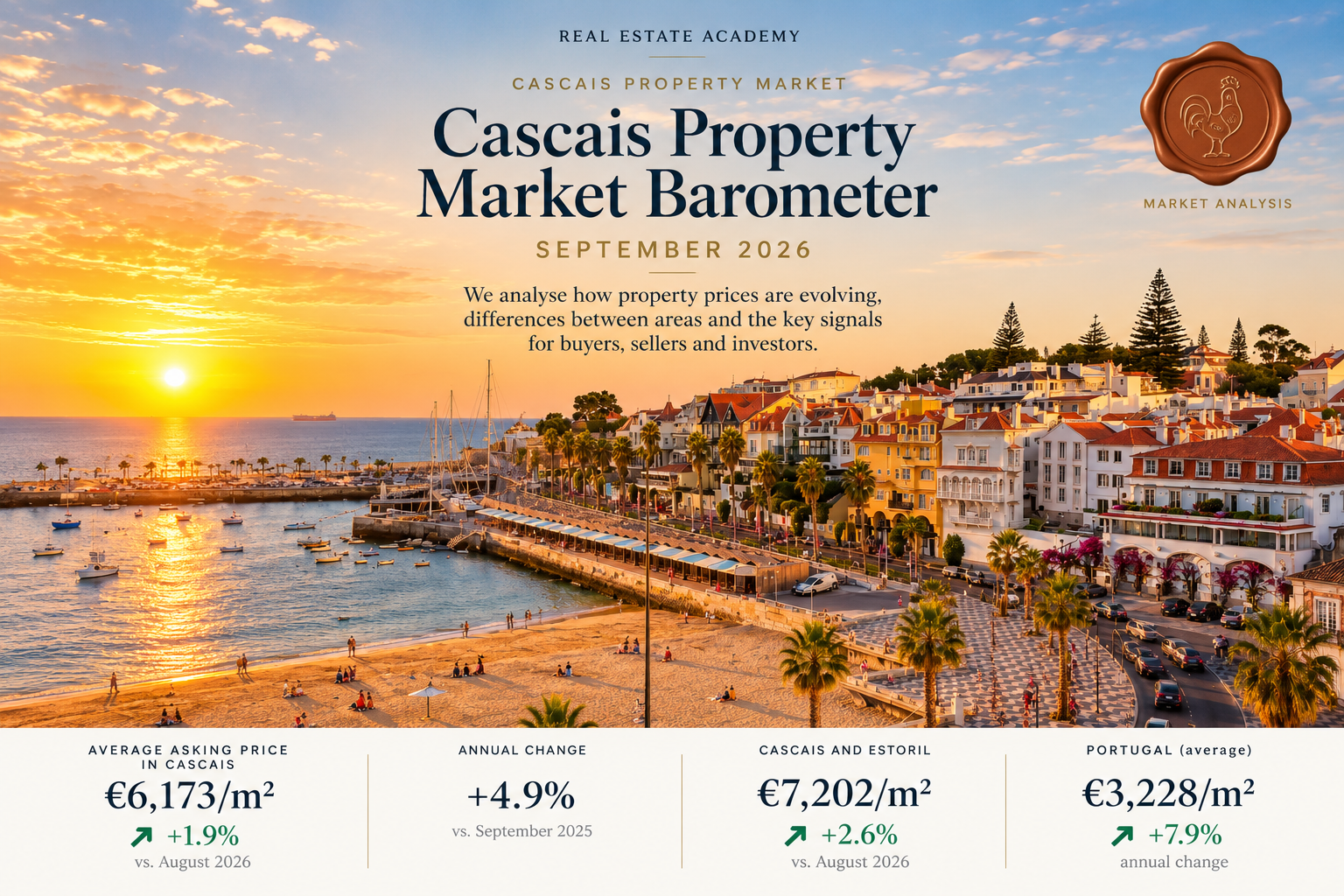
Discover how property asking prices evolved in Cascais in September 2026, with insights into local market trends, Lisbon, Oeiras and investment opportunities.
Property asking prices are rising again. What do the latest figures tell us about the Cascais real estate market?
After three consecutive months of slight declines, September brought a recovery in residential property asking prices in Cascais.
But is this increase enough to signal a renewed upward trend? And are all areas of the municipality experiencing the same market dynamics?
In this first edition of the Portugal Easylife Property Market Barometer, we examine the main residential market indicators, explore differences between locations and explain what these figures mean for buyers, homeowners and investors.
1. September at a Glance
The average residential property asking price in the municipality of Cascais reached €6,173/m² in September 2026, representing an increase of 1.9% compared with August and 4.9% compared with September 2025.
In Cascais and Estoril, asking prices were even higher, reaching €7,202/m², with a monthly increase of 2.6%.
By comparison, the national average stood at €3,228/m², reflecting annual growth of 7.9%.
These figures confirm Cascais’ position among Portugal’s most highly valued residential property markets. However, they also reveal a different pace of growth compared with the national trend: while Portugal recorded stronger annual growth, Cascais continues to command significantly higher property prices.
2. How Have Property Prices Evolved Throughout 2026?
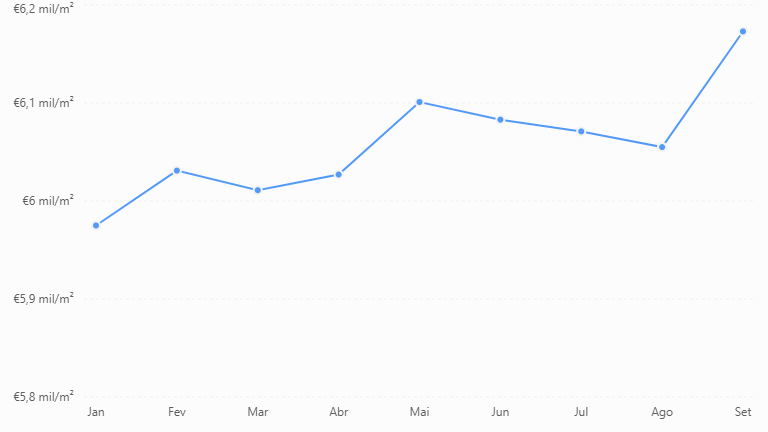
The evolution of asking prices in Cascais during the first nine months of 2026 has not followed a consistent upward trend.
The year began with an average asking price of €5,975/m² in January. Following some fluctuations, prices reached €6,101/m² in May, before recording three consecutive months of slight declines.
By August, the average stood at €6,055/m².
September interrupted this downward sequence, with prices recovering to €6,173/m².
Although this increase is noteworthy, a single month is not sufficient to confirm a sustained upward trend.
Monthly fluctuations may reflect changes in the composition of properties advertised for sale, including the introduction or withdrawal of higher-value properties.
It will therefore be important to monitor the coming months to determine whether this recovery continues.
Monthly Property Price Trends in Cascais
3. Cascais Is Not a Single Property Market
One of the defining characteristics of the Cascais property market is the considerable diversity within the municipality itself.
In September, average asking prices varied significantly between its main administrative areas:
| Area | Asking price per m² | Annual change |
|---|---|---|
| Cascais and Estoril | €7,202 | +4.1% |
| Carcavelos and Parede | €5,492 | +6.1% |
| Alcabideche | €4,905 | +9.4% |
| São Domingos de Rana | €4,150 | +10.6% |
Cascais and Estoril continue to stand out for their higher property prices, reflecting established residential locations, premium properties and homes that benefit from proximity to the sea.
Carcavelos and Parede offer a diversified market, combining traditional residential neighbourhoods with new developments and highly sought-after locations.
Meanwhile, Alcabideche and São Domingos de Rana present lower average asking prices but recorded stronger annual increases.
These results demonstrate that the most expensive areas are not necessarily those experiencing the fastest growth in advertised property prices.
However, it is important not to confuse rising asking prices with actual property appreciation or higher investment returns.
4. Cascais, Lisbon and Oeiras: Neighbouring Markets, Different Realities
Comparing Cascais with neighbouring municipalities provides a broader perspective on its market positioning.
In September 2026, Lisbon recorded an average asking price of €6,256/m², Cascais stood at €6,173/m², and Oeiras at €4,880/m².
Despite their geographical proximity, these markets have distinct characteristics.
Lisbon benefits from its central urban location, extensive services and highly diverse residential offering.
Cascais stands out for its combination of quality of life, coastal proximity, established residential neighbourhoods and premium properties.
Oeiras occupies an intermediate position in many market segments, benefiting from its proximity to Lisbon and Cascais, business centres and transport connections.
The figures also show that Oeiras recorded stronger annual asking-price growth than either Cascais or Lisbon.
Nevertheless, comparing municipal averages is no substitute for analysing comparable properties, particularly when differences in location, property type and condition are significant.
5. What About the Rental Market?
The rental market remains an important part of the residential property sector, but it requires a separate analysis.
In the historical data consulted, the latest available monthly figure for Cascais was €22.8/m² in July 2026.
For September, the Lisbon Metropolitan Area recorded an average advertised rental price of €22.0/m², representing an annual increase of 9.3%.
As an equivalent municipal figure for September could not be confirmed, we have chosen not to present a monthly comparison that might mislead readers.
In future editions, we intend to monitor rental market developments consistently, distinguishing between landlords’ advertised rents and the amounts actually agreed in rental contracts, whenever reliable data is available.
6. What Do These Figures Mean for Buyers, Sellers and Investors?
For Buyers
The recovery in asking prices reinforces the importance of carefully assessing each property opportunity.
Rather than focusing exclusively on the municipality’s average price trends, buyers should understand how an individual property compares with similar alternatives in the same location.
Location, condition, construction quality, natural light, parking, outdoor spaces and proximity to amenities can justify substantial price differences between apparently similar properties.
For Sellers
An increase in advertised property prices does not necessarily mean that every property can be marketed at a higher price.
An appropriate asking price should be based on an assessment of competing properties, the home’s specific characteristics and demand within its market segment.
Setting an excessively high initial asking price may prolong the selling process and reduce interest among potential buyers.
For Investors
Property price trends are only one of several factors to consider.
Potential returns also depend on acquisition costs, taxes, maintenance expenses, rental income, vacancy periods and medium- to long-term capital appreciation prospects.
Consequently, an area experiencing faster asking-price growth does not automatically represent a better investment opportunity.
7. Portugal Easylife’s Market Perspective
September 2026 was marked by a recovery in residential property asking prices in Cascais, following three months of slight declines.
The monthly increase of 1.9% deserves attention, but developments over the coming months will be important in determining whether this represents a sustained recovery or a temporary fluctuation.
The analysis of individual areas also highlights an essential reality: the Cascais property market is made up of several distinct local markets, each with its own characteristics, price levels and dynamics.
This is precisely why we believe that property decisions should be based on up-to-date information, local market knowledge and a careful assessment of each individual property.
At Portugal Easylife, we closely follow market developments to help our clients understand not only what a property may be worth, but also the factors influencing its value.
Because understanding the market is the first step towards making a well-informed decision.
Methodological Note
The indicators presented refer to property asking prices advertised on real estate portals and do not necessarily reflect final transaction prices. Average figures may be influenced by the composition of properties available for sale and by methodological changes introduced by data providers.
The reported changes should not be interpreted as forecasts of future property appreciation, nor do they replace an individual property valuation.
Main source: idealista, historical residential property sale and rental price reports, covering the periods indicated. Information consulted in October 2026.
